
2026-06-23
Hydrogen projects in 2026 are scaling from pilots to real infrastructure — production, purification, storage, and fueling. In this chain, compression is one of the most critical and risk-sensitive steps because hydrogen demands tight leak control, clean gas handling, and reliable high-pressure operation. This guide explains why the diaphragm compressor is widely chosen for hydrogen service, and what to evaluate when sourcing a diaphragm compressor for sale for your specific application.
Hydrogen presents challenges that most industrial gases do not. Its molecule is the smallest in existence — it migrates through materials that would contain heavier gases. It causes embrittlement in certain metals over time. And hydrogen purity is critical for fuel cell applications, where even trace hydrocarbon contamination degrades performance.
| Hydrogen Challenge | Compression Implication |
|---|---|
| Small molecule — high leakage tendency | Requires superior sealing design and leak detection |
| Embrittlement risk in susceptible metals | Materials selection must be confirmed for hydrogen service |
| Purity sensitivity for fuel cells and clean processes | Oil contamination from the compressor is not acceptable |
| Flammability range (4–75% in air) | Containment design and venting strategy are safety-critical |
Electrolyzer outlet pressure boost: compressing low-pressure hydrogen from electrolyzers to storage pressure
Tube trailer and cylinder filling: high-pressure cascade filling stations
Hydrogen refueling station cascades: compressing to 350 bar or 700 bar for vehicle fueling
Laboratory and industrial supply: controlled purity delivery at defined pressures
Define these parameters clearly before any supplier conversation: inlet pressure, outlet pressure, required flow rate, gas purity specification, operating temperature range, and duty cycle (continuous vs. intermittent). Without these, a quotation cannot be accurate.
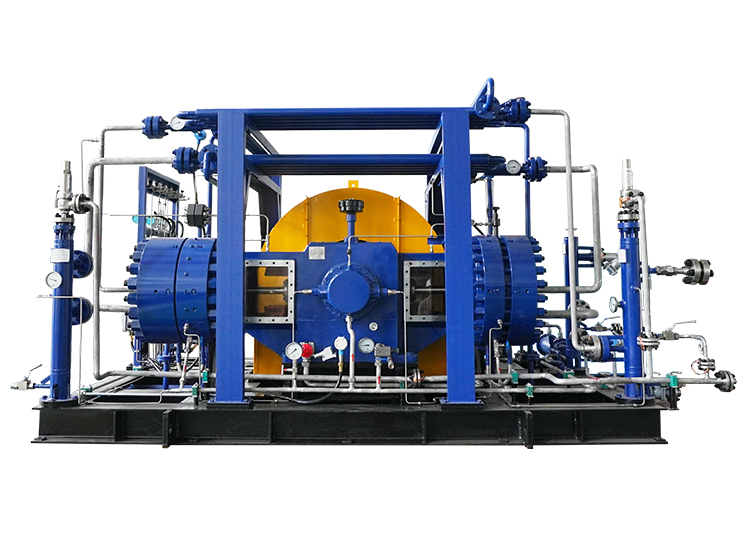
A diaphragm compressor uses a flexible membrane — the diaphragm — to compress gas. The diaphragm is driven by hydraulic oil on one side, while the process gas is entirely on the other side. The two sides never contact each other.
| Component | Function | Hydrogen Benefit |
|---|---|---|
| Diaphragm (typically multi-layer) | Flexible membrane that compresses the gas | Physically isolates gas from all lubricants |
| Gas chamber | Sealed cavity containing the process gas | Fully oil-free compression environment |
| Hydraulic drive | Oil-side actuation of the diaphragm | Mechanical drive separated from gas path |
| Valve assembly | Inlet and outlet check valves | Controls gas flow direction per cycle |
The diaphragm design eliminates the contamination pathway that exists in piston compressors where piston rings and cylinder lubricant can introduce hydrocarbons into the gas stream. For applications where hydrogen purity above 99.999% is required — fuel cells, semiconductor processes, precision laboratory work — this physical separation is the key advantage.
High-pressure applications (200–700 bar and above)
Purity-critical applications where oil contamination is not acceptable
Lower-to-medium flow rates where the diaphragm displacement volume suits the capacity requirement
Applications requiring extremely low leak rates to atmosphere
The gas-tight separation in a diaphragm compressor provides inherent safety advantages for hydrogen — the most flammable industrial gas in common use.
| Safety Feature | How It Works | Operational Benefit |
|---|---|---|
| Gas-tight diaphragm separation | Gas never contacts crankcase or oil system | Prevents internal ignition sources from reaching the gas path |
| Diaphragm rupture detection | Pressure sensor detects oil-side or gas-side pressure change | Early warning of diaphragm failure before external leak develops |
| Controlled vent design | Relief valves and purge connections in defined locations | Hydrogen vented safely to designed discharge point |
| Pressure relief valves | Set at defined relief pressure | Protects against over-pressure events |
What diaphragm material is specified for hydrogen compatibility? (PTFE and stainless steel are common choices)
What metallurgy is used for gas-wetted components — confirmed for hydrogen embrittlement resistance?
Is a diaphragm rupture detection system included as standard?
What is the designed leak rate to atmosphere under normal operating conditions?
What purging and inerting connections are provided for safe startup, shutdown, and maintenance?
Remote monitoring of operating pressure, temperature, and diaphragm condition where available
Alarm outputs for high-pressure, high-temperature, and diaphragm rupture events
Maintenance documentation confirming service intervals and inspection records for safety-critical components
A diaphragm compressor is mechanically reliable when the key wear components — diaphragm, valves, seals — are maintained on schedule. Most unplanned downtime events in diaphragm compressor operation trace back to one of three causes: diaphragm fatigue, valve wear, or inadequate cooling.
| Reliability Factor | What to Monitor | Action |
|---|---|---|
| Diaphragm condition | Operating hours; pressure history; any anomaly in rupture sensor | Replace at manufacturer-recommended interval — do not run to failure |
| Valve assembly | Valve leak-by; pressure efficiency decline | Inspect and replace valve discs and seats on schedule |
| Cooling system | Operating temperature vs. design temperature | Maintain cooling water flow and quality; check heat exchanger condition |
| Oil condition (hydraulic side) | Oil cleanliness and level | Change at defined intervals; contaminated oil accelerates diaphragm wear |
Stock diaphragm replacement kits specific to your compressor model — lead time from overseas suppliers can be 8–12 weeks
Maintain a valve repair kit covering disc and seat replacements for each stage
Define service intervals in operating hours, not calendar time — actual duty cycle determines wear rate
Confirm whether in-house maintenance is possible with training or whether factory service is required for major overhauls
| Cost Factor | Diaphragm Compressor | Alternative (e.g., Reciprocating Piston) |
|---|---|---|
| Purchase price | Higher for equivalent pressure class | Lower in some configurations |
| Oil contamination risk | Very low — design advantage | Higher — requires oil removal filters |
| Maintenance cost per year | Predictable — diaphragm and valves | Variable — more wear interfaces |
| Downtime risk | Low when scheduled maintenance is followed | Moderate — more failure modes |
| Purity system cost | Lower — no downstream oil removal needed | Higher if purity is required |
| Parameter | What to Define | Example |
|---|---|---|
| Gas type and purity | Hydrogen; specify inlet purity grade | 99.999% H2 from electrolyzer outlet |
| Inlet pressure | Absolute pressure at suction | 5 bar(a) |
| Outlet pressure | Required discharge pressure | 450 bar(a) |
| Required flow rate | Normal cubic metres per hour or kg/day | 50 Nm3/h |
| Operating temperature | Ambient and inlet gas temperature | 5–40°C ambient; 25°C inlet gas |
| Duty cycle | Continuous, intermittent, or defined hours per day | 20 hours per day, 330 days per year |
| Site classification | Hazardous area zone classification | Zone 1 / ATEX Zone 1 or equivalent |
| Noise limit | Maximum permissible sound pressure level | 85 dB(A) at 1 m |
Skid package: confirm whether a complete skid with controls, cooling, and instrumentation is required or just the compressor unit
Electrical area classification: confirm motor and control panel specification for the hazardous area classification at your site
Standards and certifications: specify applicable pressure vessel codes (ASME, PED, or local equivalent) and any required third-party certification
Control system interface: define required communication protocol (4–20 mA, Modbus, Profibus, or other)
Before any diaphragm compressor for sale leaves the factory for a hydrogen infrastructure project, the acceptance test plan should include:
Performance test confirming flow, pressure ratio, and power consumption at specified operating point
Leak test at maximum operating pressure confirming compliance with the specified leak rate standard
Functional test of all safety systems — diaphragm rupture detection, relief valves, and alarm outputs
Documentation package: test records, material certificates, inspection reports, operation and maintenance manual
As hydrogen infrastructure scales in 2026, reliability and purity are non-negotiable. A diaphragm compressor remains the go-to solution for many hydrogen compression stages because it provides oil-free, high-purity compression with strong leak control and a well-understood maintenance model. The key is correct sizing, confirmed materials compatibility for hydrogen service, and a maintenance plan aligned to your actual duty cycle.
Q1: Why is a diaphragm compressor commonly chosen for hydrogen applications?
The diaphragm physically separates the process gas from all lubricants and mechanical components, enabling oil-free compression with very low leak rates. For hydrogen — which is highly sensitive to contamination and has a wide flammability range — this separation is a fundamental safety and purity advantage over lubricated reciprocating designs.
Q2: What information do I need to request an accurate diaphragm compressor for sale quotation?
Gas type and purity, inlet pressure, outlet pressure, required flow rate, inlet gas temperature, ambient temperature, duty cycle, site hazardous area classification, applicable standards and certifications, noise limits, and whether a complete skid package or compressor unit only is required.
Q3: Are diaphragm compressors limited to small flow rates?
They are most commonly applied in lower-to-medium flow applications at high pressure — this is where the diaphragm displacement design is most competitive. For very high flow rates at moderate pressures, other compressor types may be more suitable. The correct answer depends on your specific pressure ratio, flow requirement, and purity specification.
Q4: What maintenance items should I plan for in a hydrogen diaphragm compressor?
The primary scheduled maintenance items are diaphragm replacement (at manufacturer-specified operating hour intervals), valve disc and seat replacement, hydraulic oil changes, and cooling system inspection. Stock spare diaphragm kits before commissioning — lead times for specialty diaphragm materials can be significant.
Q5: How do I ensure safe operation of a diaphragm compressor in hydrogen service?
Confirm that all gas-wetted components use hydrogen-compatible materials confirmed for embrittlement resistance. Specify diaphragm rupture detection as a standard feature. Ensure relief valves and vent connections discharge to a safe location. Follow the manufacturer's purging and inerting procedures for startup, shutdown, and maintenance access. Implement a preventive maintenance schedule based on operating hours rather than calendar time.
 Call us on:
  Email Us:
  Collaborative Innovation Industrial Park, No. 130 Yinhe Road, Southeast Development Zone, Changshu, Jiangsu Province